Knight Capital | 2012-08-01T00:00:00Z
Knight Capital 2012: A Deployment Failure With a $460 Million Loss
On August 1, 2012, an incomplete deployment left one Knight Capital server running defective dormant code activated by a repurposed flag. Erroneous trading followed, resulting in a loss of approximately $460 million.
Incident answer
Impact: Erroneous orders disrupted trading and generated a loss of approximately $460 million for Knight Capital.
Root cause: A missed server update and a reused activation flag exposed defective legacy functionality, while inadequate controls failed to contain the output.
Lesson: Verify deployment state across the fleet and enforce independent limits on harmful output.
What caused Knight Capital's 2012 incident?
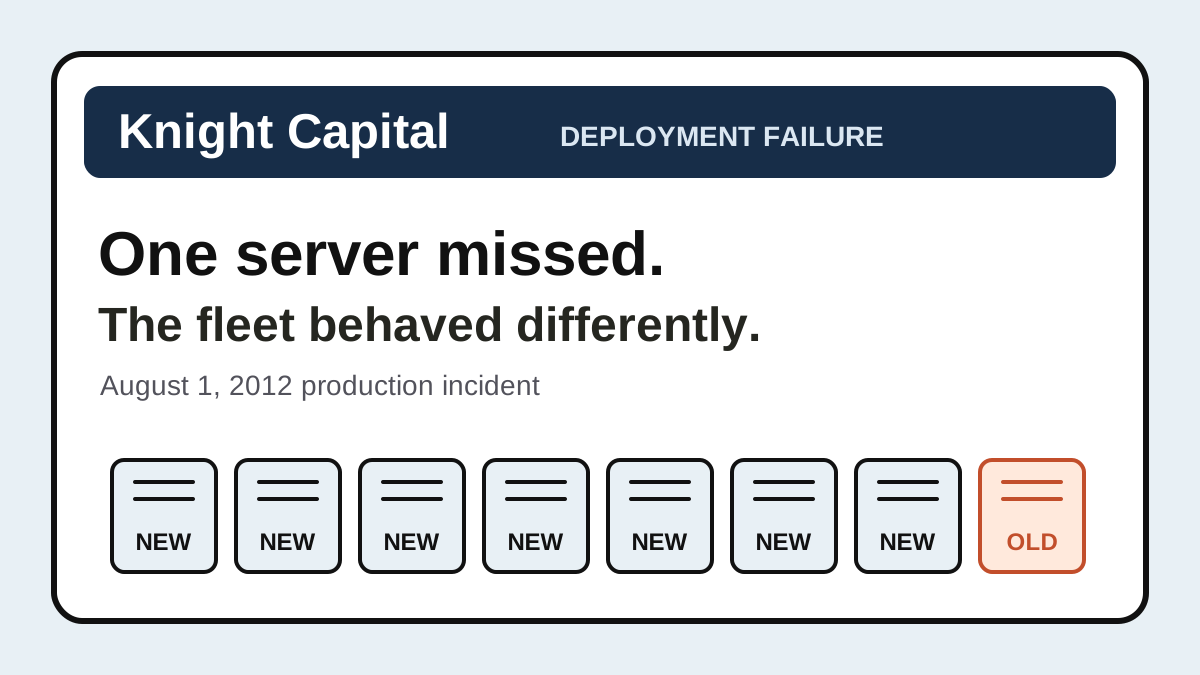
On August 1, 2012, Knight Capital's automated trading system generated erroneous orders following an incomplete software deployment. The SEC's 2013 findings describe new code installed on seven of eight servers. On the remaining server, a repurposed flag activated defective legacy functionality called Power Peg.
The SEC reported approximately 45 minutes of erroneous activity and a loss of roughly $460 million. Its enforcement announcement also identifies deficiencies in deployment procedures, output controls, and incident response. This was a failure of several protective layers, rather than a complete explanation in the phrase “bad deployment.”
Why the mixed deployment state mattered
The same flagged input reached servers with different software behavior. Seven processed the new functionality; the eighth entered the old path. The SEC also found that removing the new code from the seven updated servers during response worsened the problem by exposing the legacy behavior more widely. Source: SEC order, deployment and incident response findings.
The useful general lesson is to reason about the complete running state: executable version, configuration, input semantics, and routing. Rolling back one of those dimensions does not establish that the resulting combination is safe.
Treat a deployment as a set of observable invariants
For your own service, decide what must be true after a release. Possible invariants include:
- Every intended replica reports the expected executable and configuration revision.
- An input flag has a compatible meaning on every replica that can receive it.
- Removed behavior cannot be reached through an old version or fallback path.
- A rollback target is compatible with the current schema and message format.
- Output stays within independently enforced limits.
These are proposed engineering checks, not a description of Knight Capital's current systems. Select invariants that match your service's actual failure costs.
A deployment tool reporting success is one observation. Comparing the live fleet with the intended state and exercising representative behavior provides additional evidence.
Design the stop mechanism before the emergency
Many systems can cause damage while remaining responsive: sending duplicate emails, charging twice, publishing incorrect inventory, or repeatedly executing jobs. In those systems, process health is a weak proxy for correctness.
Ask what limits the harmful output if application logic fails. Can the responder stop the relevant path without taking down unrelated functions? Does the stop control depend on the same component that might be malfunctioning? Can it be exercised safely during a drill?
Also consider the denominator. An output count may look normal without comparison to incoming work or expected business activity. A useful dashboard can distinguish one logical operation from its downstream effects.
A practice exercise: one replica tells a different story
Use three local toy workers and synthetic jobs with no external side effects. Give one worker an older handler and a configuration flag whose interpretation differs from the newer version. Record the worker identifier, handler version, flag value, and output count for each input.
Brief the participant only on intermittent incorrect output. Ask them to:
- Group failures by replica and software revision.
- Explain why the same input produces different results.
- Propose a way to contain output while investigating.
- Check a candidate fix and a candidate rollback against every replica.
- Verify completed work against the input list.
The goal is to demonstrate consistent behavior and bounded effects. A fleet-wide average that hides the inconsistent replica should not pass the exercise.
Use the distributed systems debugging guide to structure the investigation, then document the decision with the postmortem template. For prepared runtime-configuration investigations, try a past Incident Challenge.